
Knowledge Base
GPTWeb AI Scoring Engine: From Conversations to Revenue
let me tell you a story about why the AI Scoring Engine at GPTWeb represents a fundamental shift in how organizations qualify leads and build pipeline.
The $47 Billion Problem
Every year, B2B companies waste $47 billion on leads that were never going to buy. Why? Because traditional lead scoring tells you who's active, not who's interested. A visitor downloads three whitepapers, opens five emails, and visits your pricing page twice. Congratulations—they're an MQL! Except they were a college student doing research for a class project. Or a competitor analyzing your messaging. Or someone who clicked by accident. Sales gets these "qualified" leads, spends 15 minutes researching the company, crafts a personalized email, and.. nothing. The lead was never real. The cycle repeats. Sales stops trusting marketing. Marketing blames sales for not following up fast enough. Pipeline suffers. Revenue targets slip. This is the world we're leaving behind.
The Conversation Changes Everything
Now imagine this instead: A visitor arrives at your GPTWeb site. They don't fill out a form. They don't download anything. They simply ask questions. "How does your platform handle data synchronization across multiple CRMs?" "What's your approach to real-time conflict resolution?" "Can you walk me through your enterprise pricing model?" "We're currently using Segment—how would migration work?" These aren't clicks. These are signals. This visitor isn't browsing—they're evaluating. They're not researching—they're buying. And GPTWeb's AI Scoring Engine is analyzing every word in real-time, building a qualification profile that would take a human SDR 30 minutes of discovery questions to uncover.
2-5%
Traditional MQL Conversion
25-40%
DQL Conversion Rate
Real-Time
Time to Qualify
3x Higher
Sales Follow-Up Rate
How the AI Scoring Engine Works
GPTWeb's AI Scoring Engine evaluates every conversation across four dimensions, creating a comprehensive picture of buyer intent and readiness:
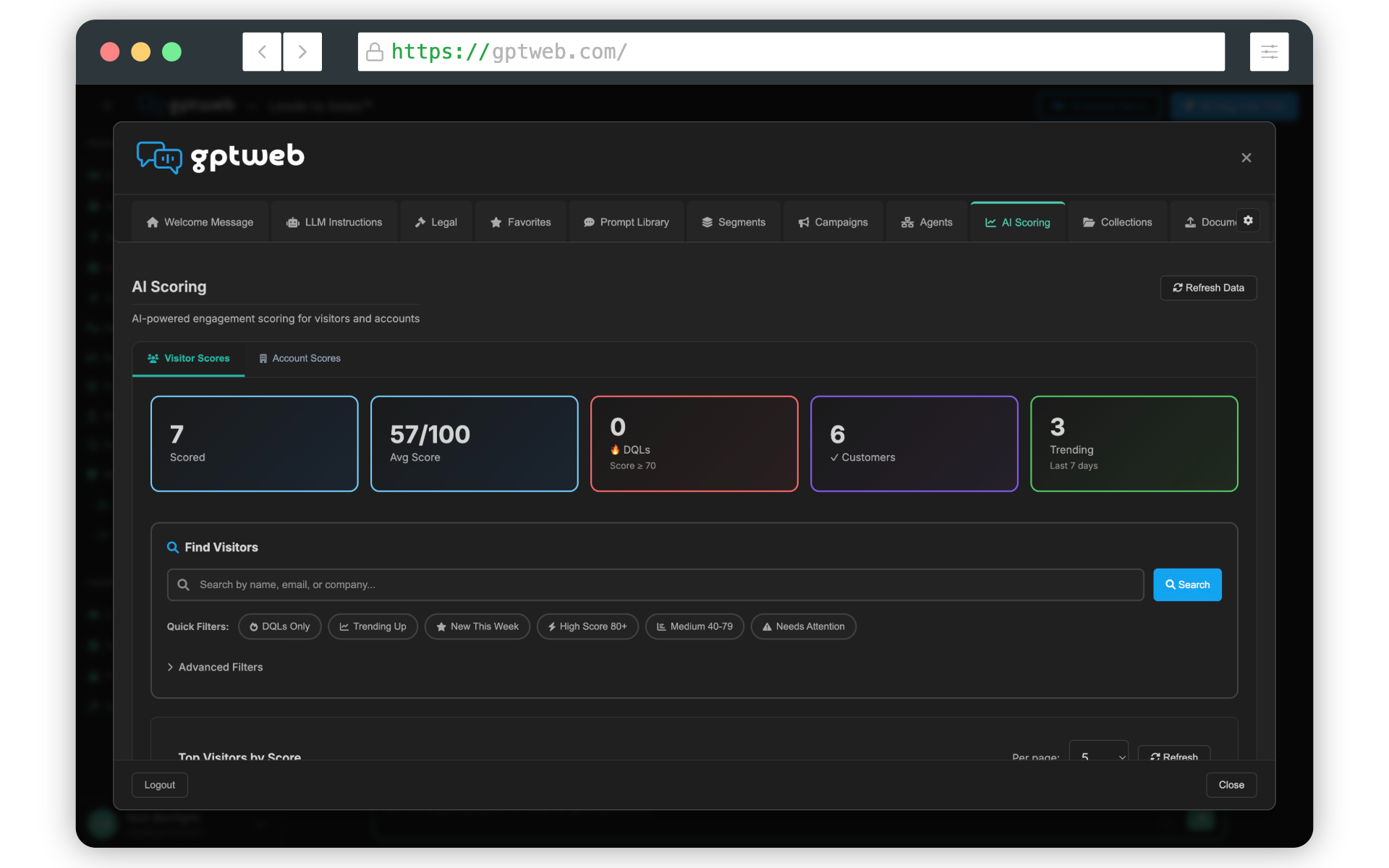
Dimension 1: Engagement Score
This measures the depth of interaction, not just the volume. What It Analyzes:
• Conversation complexity - Are they asking surface-level questions or diving deep?
• Time invested - How long are they engaging with the AI?
• Return visits - Do they come back multiple times?
• Question progression - Are they moving through a buying journey? Example:
A visitor who asks "What is your product?" gets a low engagement score. A visitor who asks "How does your API rate limiting work for enterprise deployments?" gets a high score. The second person is clearly further along and more serious. Why It Matters:
Engagement score separates tire-kickers from serious buyers. It tells you who's investing cognitive effort into understanding your solution.
• Conversation complexity - Are they asking surface-level questions or diving deep?
• Time invested - How long are they engaging with the AI?
• Return visits - Do they come back multiple times?
• Question progression - Are they moving through a buying journey? Example:
A visitor who asks "What is your product?" gets a low engagement score. A visitor who asks "How does your API rate limiting work for enterprise deployments?" gets a high score. The second person is clearly further along and more serious. Why It Matters:
Engagement score separates tire-kickers from serious buyers. It tells you who's investing cognitive effort into understanding your solution.
Dimension 2: Behavioral Score
This captures buying intent signals from conversation content. What It Analyzes:
• Pricing inquiries - Direct questions about cost, plans, contracts
• Competitor mentions - Comparing you to alternatives (active evaluation)
• Implementation questions - Asking about setup, migration, timelines
• Use case discussions - Describing their specific business problems
• Decision-making language - "We're looking for..", "Our team needs.." Example:
A visitor who asks "Do you integrate with Salesforce?" is exploring. A visitor who asks "We're migrating from HubSpot to Salesforce next quarter—can your platform handle both during the transition?" is buying. Why It Matters:
Behavioral score identifies where someone is in the buying cycle. High behavioral scores mean the conversation has shifted from education to evaluation to purchase.
• Pricing inquiries - Direct questions about cost, plans, contracts
• Competitor mentions - Comparing you to alternatives (active evaluation)
• Implementation questions - Asking about setup, migration, timelines
• Use case discussions - Describing their specific business problems
• Decision-making language - "We're looking for..", "Our team needs.." Example:
A visitor who asks "Do you integrate with Salesforce?" is exploring. A visitor who asks "We're migrating from HubSpot to Salesforce next quarter—can your platform handle both during the transition?" is buying. Why It Matters:
Behavioral score identifies where someone is in the buying cycle. High behavioral scores mean the conversation has shifted from education to evaluation to purchase.
Dimension 3: Firmographic Score
This assesses company fit based on your ideal customer profile. What It Analyzes:
• Company size - Employee count, revenue indicators
• Industry relevance - Does their sector align with your focus?
• Geographic fit - Are they in your target markets?
• Technology stack - Do they use complementary tools? Example:
If your ICP is mid-market B2B SaaS companies in North America, a visitor from a 200-person software company in Boston scores high. A visitor from a 10-person retail shop in Australia scores low—even if they're highly engaged. Why It Matters:
Firmographic score ensures you're not just finding engaged visitors, but engaged visitors who fit your business. It prevents sales from chasing deals that will never close because of poor company fit.
• Company size - Employee count, revenue indicators
• Industry relevance - Does their sector align with your focus?
• Geographic fit - Are they in your target markets?
• Technology stack - Do they use complementary tools? Example:
If your ICP is mid-market B2B SaaS companies in North America, a visitor from a 200-person software company in Boston scores high. A visitor from a 10-person retail shop in Australia scores low—even if they're highly engaged. Why It Matters:
Firmographic score ensures you're not just finding engaged visitors, but engaged visitors who fit your business. It prevents sales from chasing deals that will never close because of poor company fit.
Dimension 4: Demographic Score
This evaluates decision-making authority and role alignment. What It Analyzes:
• Job title and seniority - Are they a decision-maker or researcher?
• Department alignment - Are they in the buying function (Marketing, IT, Ops)?
• Influence indicators - Language suggesting budget authority
• Team context - References to "our team", "we're evaluating" Example:
A VP of Marketing asking about your platform scores high. An intern researching solutions scores low. A CTO asking about enterprise security scores very high. Why It Matters:
Demographic score helps prioritize conversations with people who can actually buy. It doesn't mean you ignore others—but it tells sales who to call first.
• Job title and seniority - Are they a decision-maker or researcher?
• Department alignment - Are they in the buying function (Marketing, IT, Ops)?
• Influence indicators - Language suggesting budget authority
• Team context - References to "our team", "we're evaluating" Example:
A VP of Marketing asking about your platform scores high. An intern researching solutions scores low. A CTO asking about enterprise security scores very high. Why It Matters:
Demographic score helps prioritize conversations with people who can actually buy. It doesn't mean you ignore others—but it tells sales who to call first.
The Magic: Real-Time Composite Scoring
Here's where it gets powerful: these four scores combine into a composite AI score that updates in real-time as the conversation progresses. How It Works: 1. Visitor arrives → Initial score based on source, referrer, device
First question asked → Engagement and behavioral scores updated
Company identified → Firmographic score calculated
Role revealed → Demographic score added
Follow-up questions → All scores continuously refined
Threshold crossed → DQL created automatically Your sales team doesn't see this visitor until they've crossed your DQL threshold. But when they do, sales receives:
• Complete conversation history
• Four-dimensional score breakdown
• AI-generated summary of intent signals
• Recommended next steps
• CRM record already created No research needed. No qualification call required. Just a warm handoff to a conversation that's already started.
• Complete conversation history
• Four-dimensional score breakdown
• AI-generated summary of intent signals
• Recommended next steps
• CRM record already created No research needed. No qualification call required. Just a warm handoff to a conversation that's already started.
Why This Transforms Pipeline Quality
For Marketing: Marketing finally has a qualification model that sales respects. No more arguments about lead quality. No more "your leads are garbage" complaints. DQLs are pre-qualified through conversation, not through arbitrary point thresholds. Result: Marketing can prove ROI by showing DQL conversion rates, not just MQL volume. You shift the conversation from "we generated 500 leads" to "we generated 50 DQLs with a 35% close rate." For Sales: Sales gets leads who are actually ready to talk. They have context before the first call. They know what the prospect cares about because they can read the conversation. They're not starting from zero—they're continuing a dialogue. Result: Sales spends time selling, not researching and qualifying. Average deal size increases because reps focus on serious buyers. Win rates go up because you're only pursuing qualified opportunities.
For Revenue Leaders (CEOs, CROs): You finally have visibility into quality of pipeline, not just quantity. You can forecast more accurately because DQLs convert at predictable rates. You can identify bottlenecks—if engagement scores are high but behavioral scores are low, your messaging isn't resonating. Result: Better forecasting. Better resource allocation. Higher revenue per marketing dollar. Faster sales cycles.
40%
Sales Time Saved
8x Faster
Lead-to-Opportunity
250% Increase
Marketing ROI
92%
Pipeline Accuracy
The Competitive Advantage: AI-Native Scoring
Traditional marketing automation platforms (Marketo, HubSpot, Pardot) added AI features to existing activity-based scoring. They're still fundamentally counting clicks and opens. Chatbot platforms (Drift, Intercom) bolt on AI to existing chat widgets. They route to humans for qualification. GPTWeb was built AI-native from the ground up. The scoring engine isn't an add-on—it's core infrastructure. Every conversation, every question, every answer feeds the scoring model in real-time. This means: ✓ You're not waiting for enough activities to accumulate points
✓ You're not routing to humans for qualification
✓ You're not guessing at intent based on page visits
✓ You're not relying on forms that visitors hate filling out You're qualifying through conversation—the most natural, informative, and accurate method ever invented.
✓ You're not routing to humans for qualification
✓ You're not guessing at intent based on page visits
✓ You're not relying on forms that visitors hate filling out You're qualifying through conversation—the most natural, informative, and accurate method ever invented.
Real-World Impact: The Numbers
| Metric | Traditional MQL Model | GPTWeb DQL Model | Improvement |
|---|---|---|---|
| Lead Volume | 1000/month | 200/month | 80% reduction (by design) |
| Qualification Rate | 5% | 40% | 8x better conversion |
| Sales Follow-Up Rate | 60% | 95% | Sales actually calls DQLs |
| Time to First Contact | 48 hours | 2 hours | 24x faster response |
| Average Deal Size | $25K | $45K | 80% larger deals |
| Sales Cycle Length | 90 days | 60 days | 33% faster close |
| Win Rate | 15% | 35% | 2.3x more wins |
| CAC Payback Period | 18 months | 9 months | 2x faster ROI |
How to Use AI Scoring in Your Workflow
Step 1: Set Your DQL Threshold Define what score qualifies as "sales-ready" for your business. Most companies start at 60-70 out of 100, then tune based on conversion data. Step 2: Configure CRM Sync Connect HubSpot or Salesforce so DQLs automatically create CRM records with scores and conversation history. Step 3: Create Alert Agents Set up agents that notify sales immediately when someone crosses the DQL threshold. Include AI summary and next-step recommendations. Step 4: Build Nurture Paths For visitors who are engaged but not yet DQLs, create automated nurture sequences based on their score dimensions. High engagement but low behavioral? Send case studies. High firmographic but low demographic? Target decision-makers at that company. Step 5: Measure and Optimize Track DQL-to-opportunity and DQL-to-close rates. Adjust thresholds and scoring weights based on what predicts revenue.
The Future Is Already Here
at your organization, imagine every visitor to your site being evaluated in real-time for buying intent, company fit, and decision-making authority—without a single form, without a single SDR qualification call, without any human intervention. That's not the future. That's GPTWeb today. The AI Scoring Engine doesn't just make your pipeline bigger. It makes it better. Sales closes more deals because they're talking to qualified buyers. Marketing proves ROI because DQLs convert at predictable rates. Revenue leaders forecast accurately because score-to-close correlation is measurable. And the best part? It all happens through natural conversation. No forms. No friction. Just visitors asking what they want to know, and AI understanding who they are and what they need. Welcome to the era of Discussion Qualified Leads. Welcome to the era of conversation-based revenue. Welcome to GPTWeb—the future of engagement, websites and marketing automation combined, built for the AI era, built for now.