
Knowledge Base
Transforming Professional Services Proposals with GPTWeb's Multi-Media RAG Engine
this is an excellent use case that highlights one of GPTWeb's most powerful applications. Professional services teams live and die by the quality of their proposals, and the challenge has always been the same: how do you demonstrate deep understanding of the client's business while showcasing your unique expertise? GPTWeb's Two-Phase Semantic RAG Engine solves this by creating a living knowledge foundation that makes every proposal feel custom-crafted.
The Professional Services Proposal Challenge
Your services leaders face a fundamental tension: proposals need to be tailored to each prospect's specific situation, but the expertise that makes your firm valuable exists across dozens of sources, including past projects, methodologies, case studies, technical specifications, and tribal knowledge from senior consultants. Currently, creating a compelling proposal means hunting through folders, asking colleagues, and hoping you remember that perfect case study from two years ago.
How GPTWeb Powers Proposal Excellence
The Two-Phase Semantic Engine: Your Proposal Superpower
Here is where GPTWeb differentiates itself from simple document search. When a services leader asks 'What experience do we have with healthcare data migrations for companies of this size?', the engine works in two distinct phases:
- Phase 1: Collection Routing - The AI identifies which semantic collections are most relevant: Healthcare vertical, Data Migration methodology, Enterprise case studies, and Pricing models for similar scope
- Phase 2: Deep Semantic Search - Within those collections, it finds the most precise chunks: specific project outcomes, relevant technical approaches, applicable client testimonials, and pricing precedents
The result? Instead of generic boilerplate, your proposal includes specific proof points that demonstrate you understand this exact type of engagement.
What Your Proposal Knowledge Base Can Include
| Content Type | Proposal Use Case | How AI Leverages It |
|---|---|---|
| Past Proposals | Reusable sections, scope language, pricing structures | Finds relevant precedents for similar engagements |
| Case Studies | Client success stories, outcomes, testimonials | Surfaces proof points matching prospect's industry and challenges |
| Methodology Documents | Approach frameworks, phase descriptions, deliverables | Generates consistent, professional methodology sections |
| Demo Videos | Product walkthroughs, solution demonstrations | AI surfaces relevant videos to embed in digital proposals |
| Technical Specifications | Integration requirements, architecture patterns | Provides accurate technical scoping language |
| Pricing Spreadsheets | Rate cards, effort estimates, historical actuals | Answers pricing questions with data-backed estimates |
| Client Research PDFs | Industry reports, company profiles, competitive intel | Informs personalized value propositions |
Real-World Proposal Scenario
Imagine your services leader is preparing a proposal for a mid-market financial services company looking to modernize their data infrastructure. With GPTWeb, they can have a conversation like this:
'Show me our most relevant case studies for financial services data modernization projects between 500K and 2M in scope, and include any methodology frameworks we use for this type of engagement.'
The AI instantly searches across your curated knowledge base, pulling specific case study outcomes, methodology sections, and even relevant demo videos that can be embedded directly into the proposal. No hunting through SharePoint. No asking three different partners who might remember that project from 2022.
Building Your Proposal Knowledge Foundation
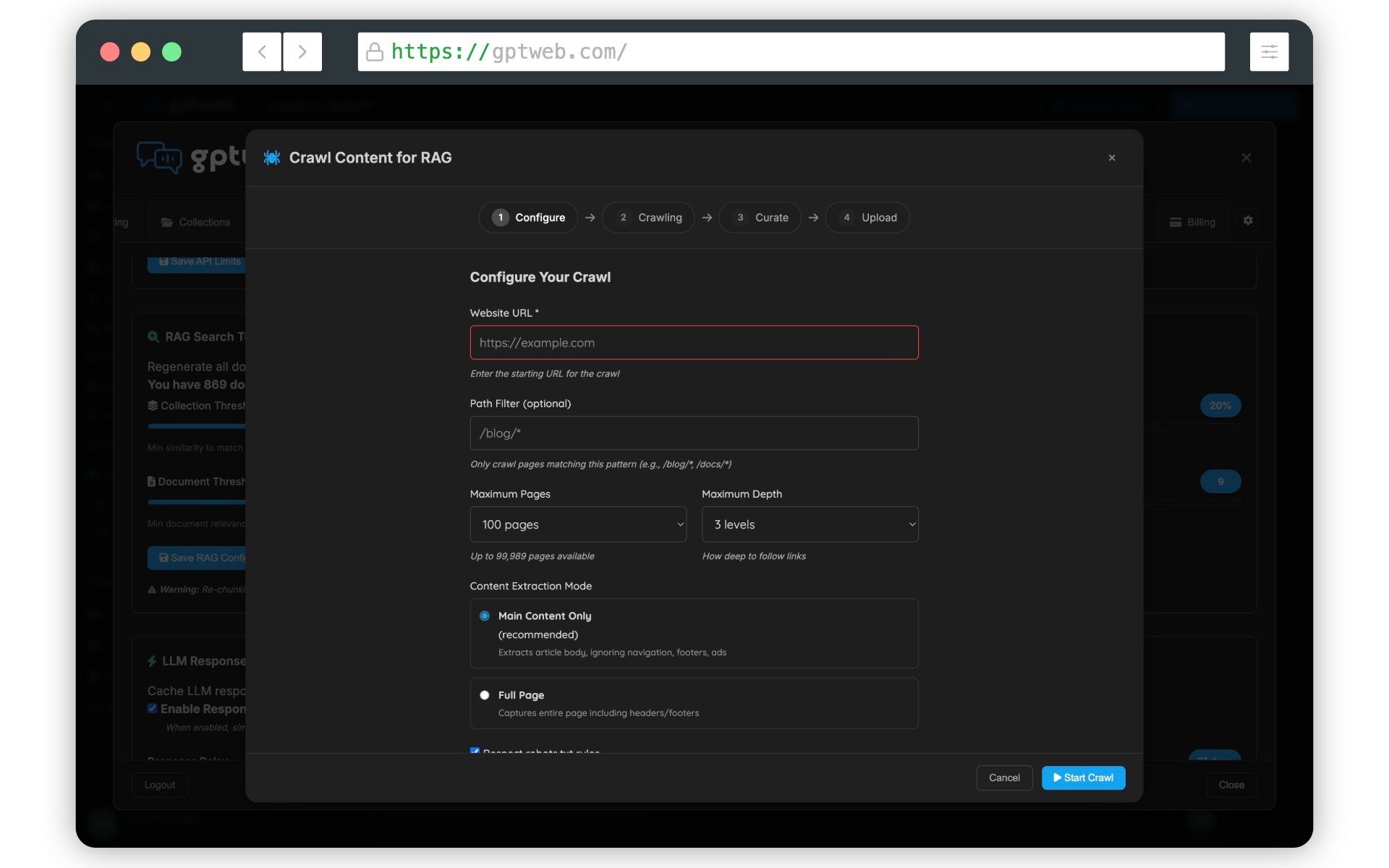
- Crawl existing content: Use the RAG Crawler to import proposals, case studies, and methodology docs from your existing repositories
- Create semantic collections: Organize by vertical (Healthcare, Financial Services, Manufacturing), engagement type (Implementation, Migration, Advisory), and content purpose (Case Studies, Methodologies, Pricing)
- Upload multimedia: Add demo videos, client testimonial recordings, and architecture diagrams that services leaders can surface during proposal creation
- Curate with experts: Have your senior consultants review and refine the knowledge base, adding the tribal knowledge that makes proposals compelling
- Enable conversational access: Services leaders can now ask natural language questions and get synthesized, relevant responses instantly
The Competitive Advantage
Reduced
Proposal Creation Time
Increased
Relevance & Personalization
Improved
Win Rate Potential
24/7
Knowledge Accessibility
| Before GPTWeb | After GPTWeb |
|---|---|
| Hours searching for relevant case studies | Instant retrieval of matching proof points |
| Generic methodology sections copy-pasted | Tailored approach language based on client context |
| Tribal knowledge locked in senior partners' heads | Institutional expertise accessible to every proposal team |
| Static proposals with text and screenshots | Dynamic proposals with embedded videos and interactive elements |
| Pricing based on memory and guesswork | Data-backed estimates from historical actuals |
Demonstrating Client Understanding
the real magic happens when you layer client research into your knowledge base. Upload industry reports, the prospect's annual reports, news articles about their challenges, and competitive intelligence. Now when your services leader asks 'What are the key challenges facing mid-market financial services firms right now, and how does our approach address them?', they get a response that weaves together:
- Industry-specific challenges from your research collection
- Your firm's relevant experience from your case study collection
- Specific methodology approaches from your frameworks collection
- Proof points and testimonials that validate your expertise
The proposal practically writes itself, and it demonstrates the kind of deep client understanding that wins engagements.
For organizations like your organization, the path to proposal excellence starts with curating your existing intellectual capital. Begin with your best 10-15 case studies, your core methodology frameworks, and your most successful past proposals. The Two-Phase Semantic Engine will immediately make that knowledge accessible to everyone on your services team, turning every proposal into a showcase of your firm's collective expertise.
GPTWeb is the future of engagement, websites, and marketing automation combined, built for the AI era, built for now. For professional services teams, it means transforming institutional knowledge into competitive advantage on every proposal.