
Knowledge Base
Anonymous Visitor Identification, Persona Matching, and Personalization
great question — this is one of the most powerful parts of the platform. GPTWeb identifies anonymous visitors through a layered approach that combines device fingerprinting, conversational signal capture, progressive profiling, and AI-driven scoring and segmentation. Every interaction enriches the visitor record, and the experience adapts in real time.
Anonymous to Known: Identification & Personalization Flow
The Identification & Personalization Pipeline
- **1. Anonymous Arrival** — Every visitor gets a persistent device/session identifier the moment they land, so their conversation history and behavior are tracked even before they share any PII. ✓
- **2. Conversational PII Capture** — When a visitor mentions an email or phone in free-form chat, the auto-identity service logs a `chat_pii_captured` activity (first-time) or `chat_pii_mentioned` activity (re-mention of known PII), creating a clean audit trail. ✓
- **3. Profile Modal Saves** — When a visitor fills the progressive profile modal, a `form_submission` activity row is written with the form name, fields submitted, and timestamp — feeding the Behavioral score's Forms bucket. ✓
- **4. Device Claim & Verification** — If a new device tries to claim an existing profile, a verification email is sent to the rightful profile owner (addressed to them by name) to prevent identity collisions. ✓
- **5. Business Email Enforcement** — Optional Profile Settings can require business emails and block shared inboxes (support@, info@, sales@), prompting visitors for their individual work address — which improves account matching. ✓
- **6. Account Matching** — Visitors are rolled up to accounts based on their verified email domain, so multiple team members from the same organization appear under one Account record. ✓
- **7. AI Scoring** — The AI Score Analysis modal combines Behavioral (forms, chat, activity), Demographic, and Memory signals into a unified score. The same logic runs at the account level, aggregating across every visitor on the account. ✓
- **8. Memory Facts** — The AI extracts categorized facts (goal, behavior, pain point, technical, context, preference) from conversations and stores them as persistent memory used to personalize future responses. ✓
- **9. Segmentation & Personalization** — AI segmentation routes the right agents, campaigns, modals, toaster alerts, and content tiles to the right visitor based on score, segment, role, and live conversation context. ✓
6+
Memory Categories
3
Score Dimensions
2
PII Signal Types
5-10 min
Embedding Refresh
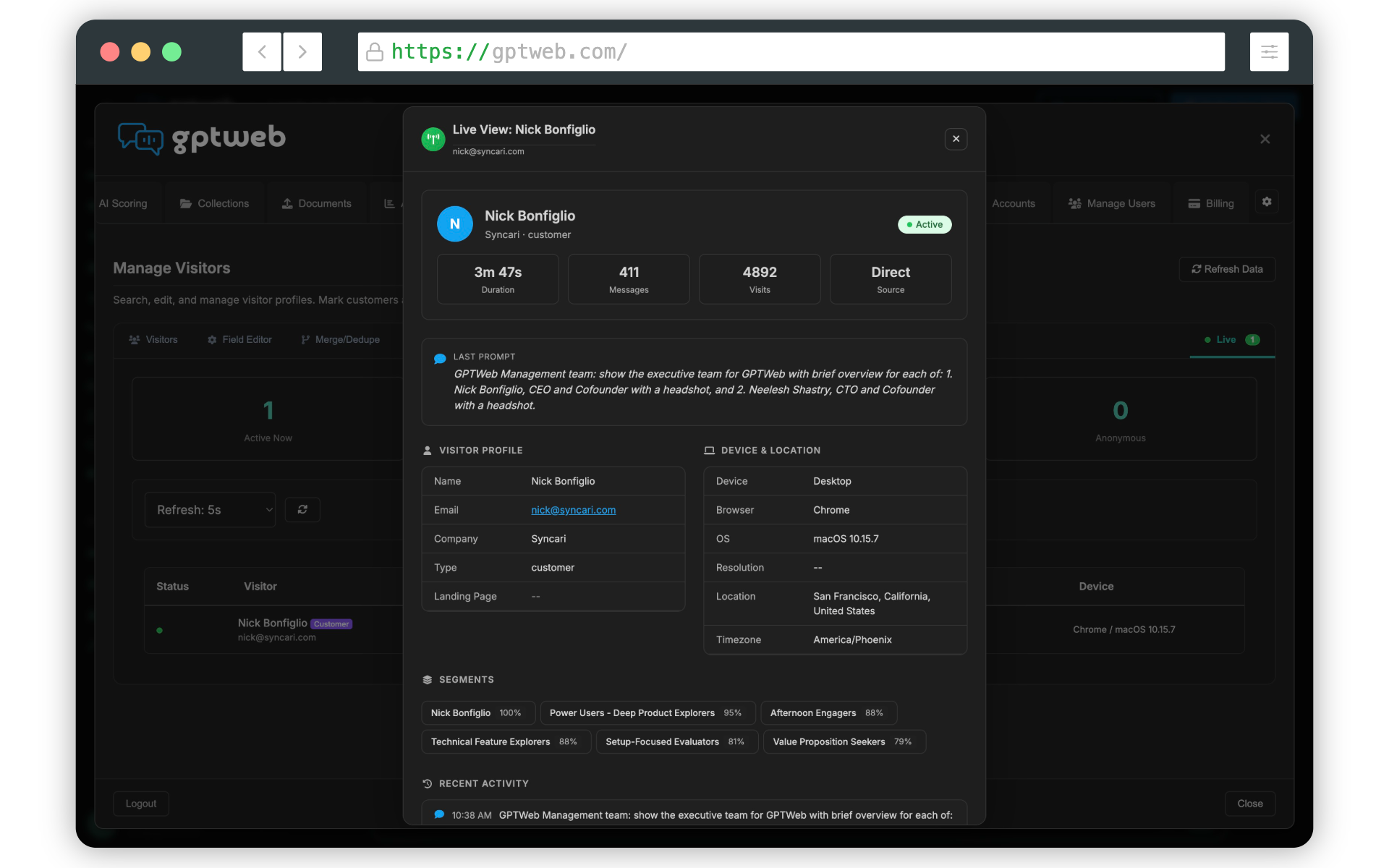
the closed loop is what makes it work for organizations like your organization: every chat turn, profile save, and form submission writes to the activity log, the scoring engine rescores in near real time, segmentation updates, and the next page render adapts. Admins can see all of this in the AI Score Analysis modal with Memory Facts, Recent Prompts, and Recent Activity — at both the visitor and aggregated account level. Curious how this would surface your own visitor Behavior and Context signals? [](gptweb://modal/demo) or jump to Getting Started. GPTWeb is the future of engagement, websites, and marketing automation combined — built for the AI era, built for now.