
Knowledge Base
GPTWeb Embed & Sidekick: Flyout, iFrame & Setup Guide
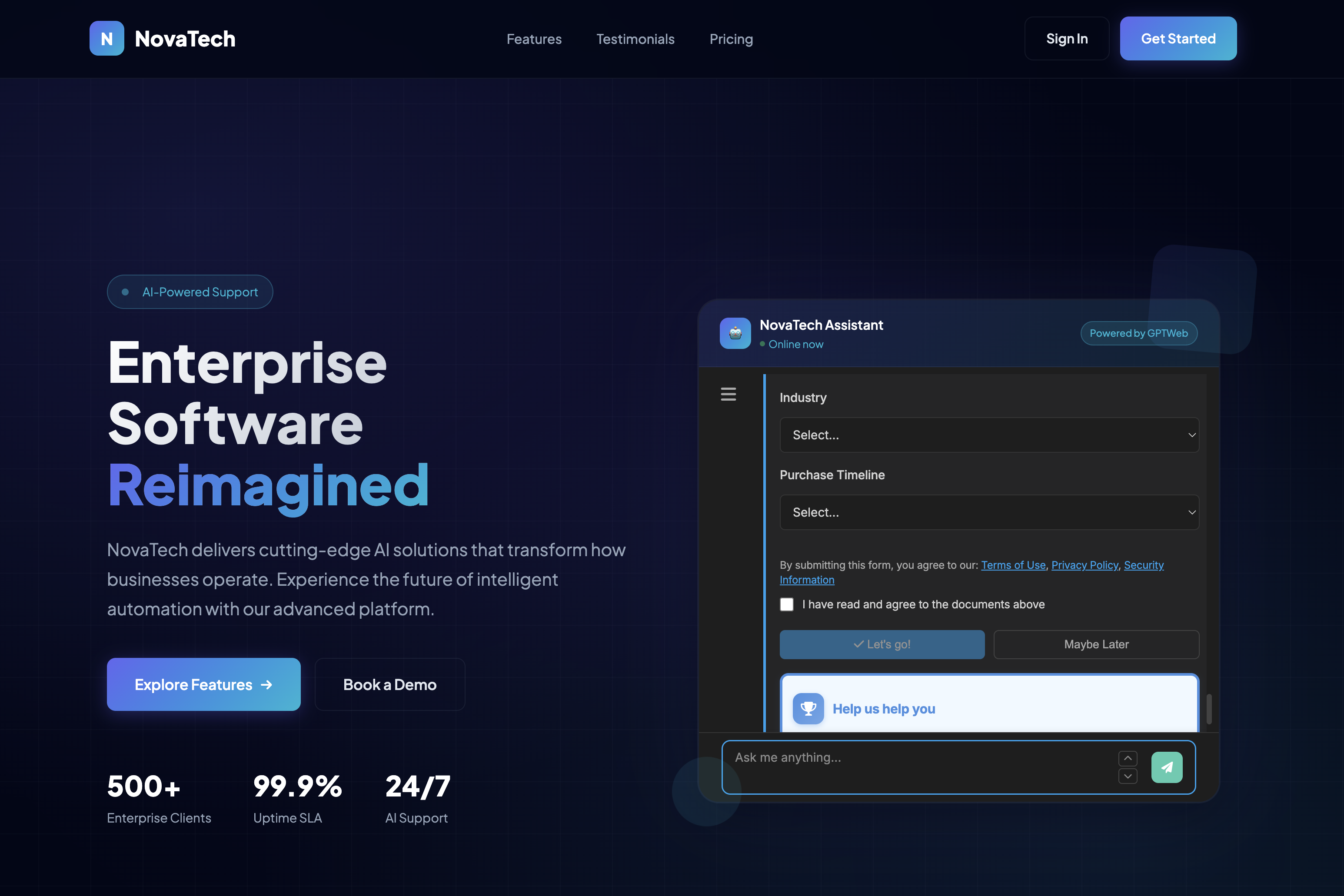
not every organization is ready to replace their existing website overnight — and GPTWeb was designed with that reality in mind. The sidekick and embed modes exist precisely to meet teams where they are today, letting you layer AI-powered conversational engagement on top of any existing web infrastructure without disruption. Whether your stack is WordPress, Webflow, Framer, or fully custom, GPTWeb lives alongside it as an intelligent companion — capturing intent, qualifying visitors, and surfacing Discussion Qualified Leads from the very first conversation. Embed modes go further by putting GPTWeb directly inside your existing pages — not as a separate destination, but as an integrated experience visitors encounter in context. A product page can embed an AI that answers technical questions. A pricing page can deploy a flyout widget that qualifies intent in real time. A help center can surface AI answers inline. This flexibility means GPTWeb adds immediate value regardless of how far along your team is on the AI web journey — and at Syncari, where visitor intent and data quality matter, that signal capture starts from the moment someone lands.
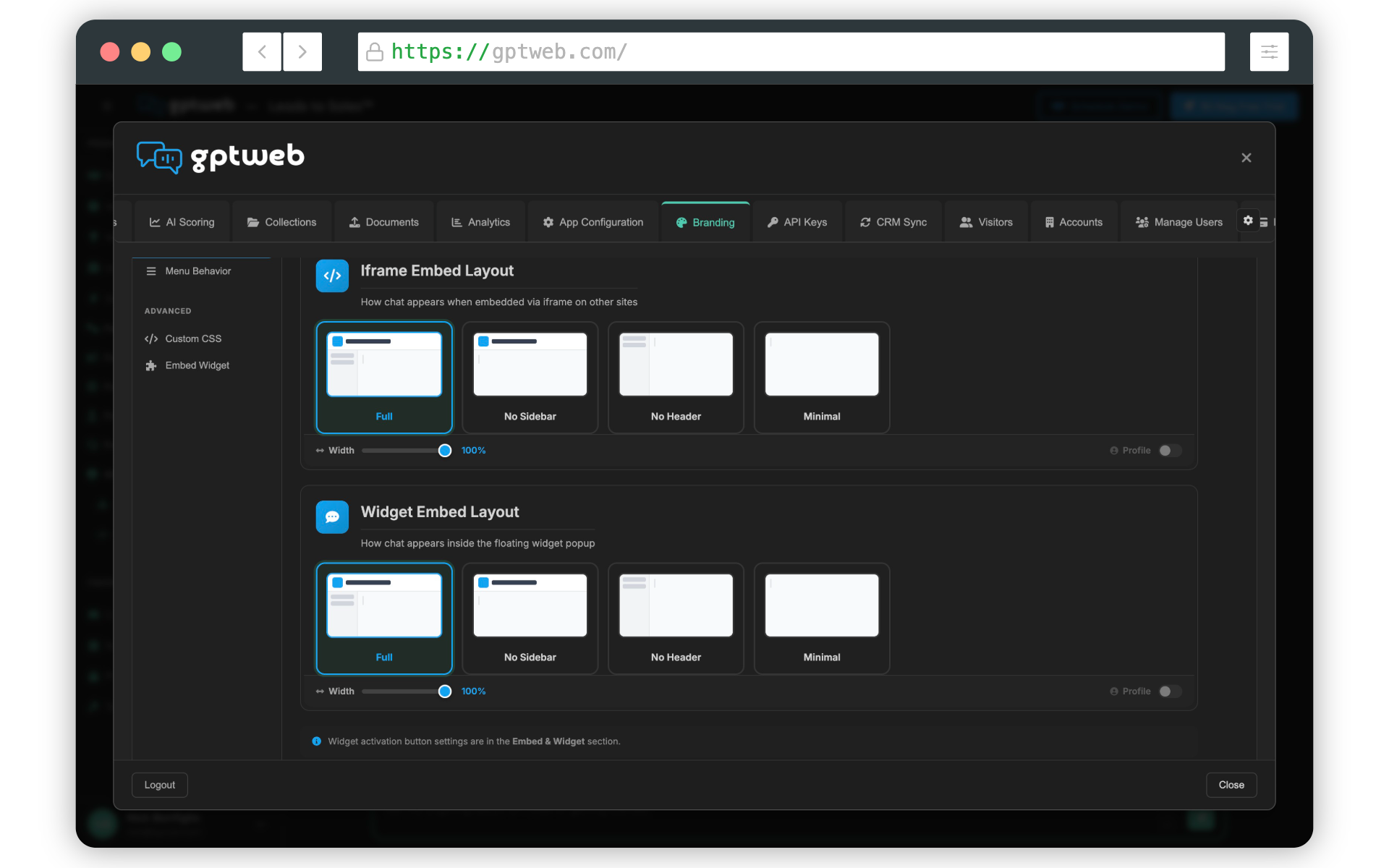
Embed Types at a Glance
| Embed Type | How It Works | Best For | Visitor Experience | Code Required |
|---|---|---|---|---|
| iFrame Embed | Renders full GPTWeb site inline inside a host webpage as an embedded panel | Dedicated chat pages, help centers, resource hubs, product pages | Full conversational UI inside the host page — no redirect or popup | One HTML snippet — copy and paste |
| Flyout Widget / Sidekick | Floating launcher button in the page corner that expands into a chat panel overlay | Any page where ambient AI availability adds value without consuming space | Non-intrusive — click to open, click to close, chat persists across pages | One JS script tag — copy and paste |
| Standalone Custom Domain | Full GPTWeb experience hosted at gpt.yourdomain.com or chat.yourdomain.com | Primary sidekick deployment, partner portals, campaign landing pages | Full-page native GPTWeb experience with your branded domain | DNS CNAME record — no code changes |
Where to Configure Embed Settings
| Setting | Admin Panel Location | What You Configure |
|---|---|---|
| Enable / Disable Embed | Branding → Customize → Embed & Widget | Toggle embed availability on or off globally |
| Widget Button Appearance | Branding → Customize → Embed & Widget | Button color, icon, position (bottom-left or bottom-right), and size |
| Allowed Domains | Branding → Customize → Embed & Widget | Whitelist domains permitted to embed your GPTWeb site — blank means unrestricted |
| iFrame Code Snippet | Branding → Customize → Embed & Widget | Copy-paste ready HTML iframe snippet pointing to your GPTWeb site URL |
| Widget Script Snippet | Branding → Customize → Embed & Widget | Copy-paste JavaScript tag for deploying the floating flyout widget on any page |
| Custom CSS | Branding → Customize → Custom CSS | Override embed UI styling to match your host site brand exactly |
| GTM / Analytics | App Configuration → GTM Config tab | Google Tag Manager and analytics tracking across embedded experiences |
| Custom Domain | Branding → Custom Domain | Configure gpt.yourdomain.com with CNAME DNS records and SSL auto-provisioning |
Step-by-Step Setup
| # | Step | Why | Where |
|---|---|---|---|
| 1 | Open Admin Panel — Mac: Cmd+Ctrl+A / Windows: Ctrl+Alt+A | All embed and widget configuration lives inside the admin panel | Keyboard shortcut on your live GPTWeb site |
| 2 | Navigate to the Branding tab | Branding houses all visual, embed, and domain customization | Admin Panel → Branding tab |
| 3 | Click the Customize sub-tab | Sub-tab organizes branding into colors, CSS, and embed sections | Admin Panel → Branding → Customize sub-tab |
| 4 | Select Embed & Widget from the left sidebar | Dedicated embed configuration panel for all embed options | Branding → Customize → Embed & Widget sidebar item |
| 5 | Toggle Embed to Enabled | Embed is disabled by default — nothing deploys until explicitly enabled | Embed & Widget → Enable toggle |
| 6 | Choose your embed type: iFrame or Flyout Widget | Determines whether GPTWeb appears inline or as a floating button | Embed & Widget → Embed Type selector |
| 7 | Configure widget/flyout appearance if using Widget mode | Set button color, corner position, and icon to match your brand | Embed & Widget → Widget appearance settings panel |
| 8 | Add allowed domains (strongly recommended) | Prevents unauthorized sites from embedding your GPTWeb experience | Embed & Widget → Allowed Domains field — one domain per line |
| 9 | Copy the generated code snippet | Pre-configured HTML or JS code for your tenant — ready to deploy | Embed & Widget → Copy Snippet button |
| 10 | Paste snippet into your target webpage HTML | Deploys GPTWeb on your host site — no rebuild or redeployment needed | Your site HTML, CMS template, or Google Tag Manager |
| 11 | Test in browser — hard refresh if embed does not appear | Confirms embed loads and domain whitelist is configured correctly | Live host website — use Cmd+Shift+R or Ctrl+Shift+R to hard refresh |
Embed Deployment Architecture
Key Technical Details
| Topic | Detail |
|---|---|
| iFrame src URL | https://app.gptweb.com/site/YOUR-SLUG — replace YOUR-SLUG with your tenant identifier |
| Flyout widget script placement | Place the widget JS tag before the closing body tag on any page |
| Framer compatibility | Yes — use window.parent.postMessage to trigger GPTWeb actions from Framer button code |
| Action links in embeds | gptweb:// links work inside embeds — e.g., [{{action.demo_label}}](gptweb://modal/demo) |
| Domain whitelisting behavior | If domains are listed, only those domains can render the embed — leave blank for unrestricted |
| Custom domain DNS | Add SSL verification CNAME and routing CNAME — SSL auto-provisioned in 5–60 minutes |
| Cache and preview issues | If embed is not loading, clear browser cache and verify domain is in the allowed list |
| Styling the embed | Custom CSS at Branding → Customize → Custom CSS — use !important for overrides |
| Chat placeholder text | Configured in Welcome Message tab → Chat Input Placeholder field (not via CSS) |
| DQL capture via embed | Every flyout and iFrame conversation generates DQL signals — same scoring and CRM sync as full site |
2 + Custom Domain
Embed Types
~10 Minutes
Setup Time
Copy & Paste Only
Code Required
Any HTML Host
CMS Compatibility
For deeper exploration, check out Embedding & Sidekick for full configuration details, Live Visitor View to track embedded visitor activity in real time, CRM Sync to see how embed conversations flow into HubSpot, and What are DQLs™? to understand how every embedded conversation generates qualified lead signals. GPTWeb is the future of engagement — websites and marketing automation combined, built for the AI era, built for now.