
Knowledge Base
Why GPTWeb? The Evolution from Documentation to Action
you just asked the fundamental question that shaped GPTWeb's entire architecture. Let me show you why we built what we built - and why it matters for organizations like your organization.
The Core Problem: Static vs. Dynamic
Traditional websites are documents. GPTWeb sites are platforms. Here's what that means: Traditional Website Thinking:
• Create pages manually
• Hope visitors navigate correctly
• Capture leads through forms
• Send generic email nurture sequences
• Score leads based on page visits
• Manually qualify before passing to sales GPTWeb Platform Thinking:
• Content generates from conversations (Conversational SEO™)
• Visitors ask questions, get instant answers
• Conversations become Discussion Qualified Leads (DQLs)
• Agents automate responses based on intent
• AI Segmentation understands visitor needs in real-time
• Sales receives context-rich, high-intent leads automatically
• Create pages manually
• Hope visitors navigate correctly
• Capture leads through forms
• Send generic email nurture sequences
• Score leads based on page visits
• Manually qualify before passing to sales GPTWeb Platform Thinking:
• Content generates from conversations (Conversational SEO™)
• Visitors ask questions, get instant answers
• Conversations become Discussion Qualified Leads (DQLs)
• Agents automate responses based on intent
• AI Segmentation understands visitor needs in real-time
• Sales receives context-rich, high-intent leads automatically
Traditional Marketing Flow vs. GPTWeb Automation
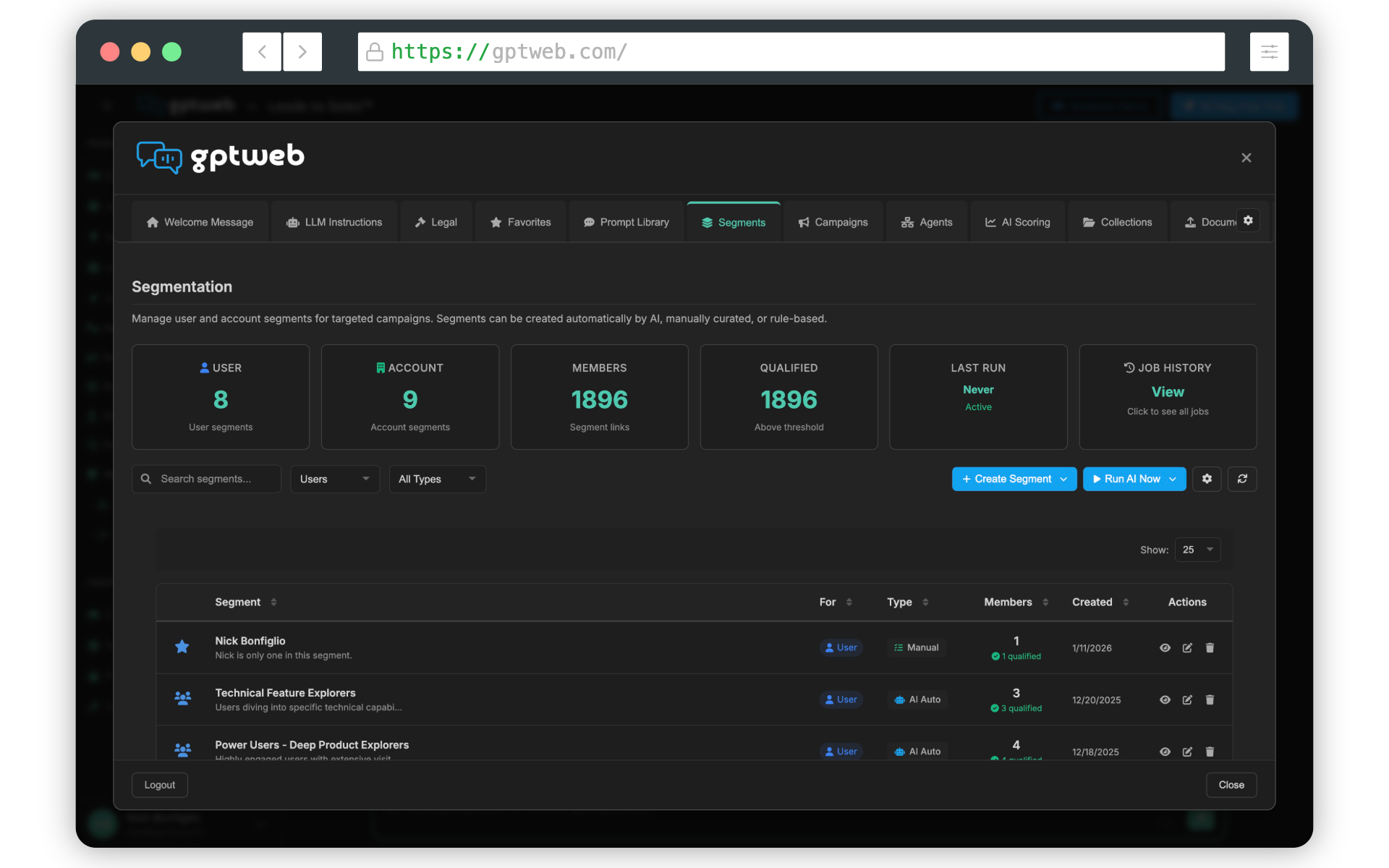
Why Agent Orchestration Changes Everything
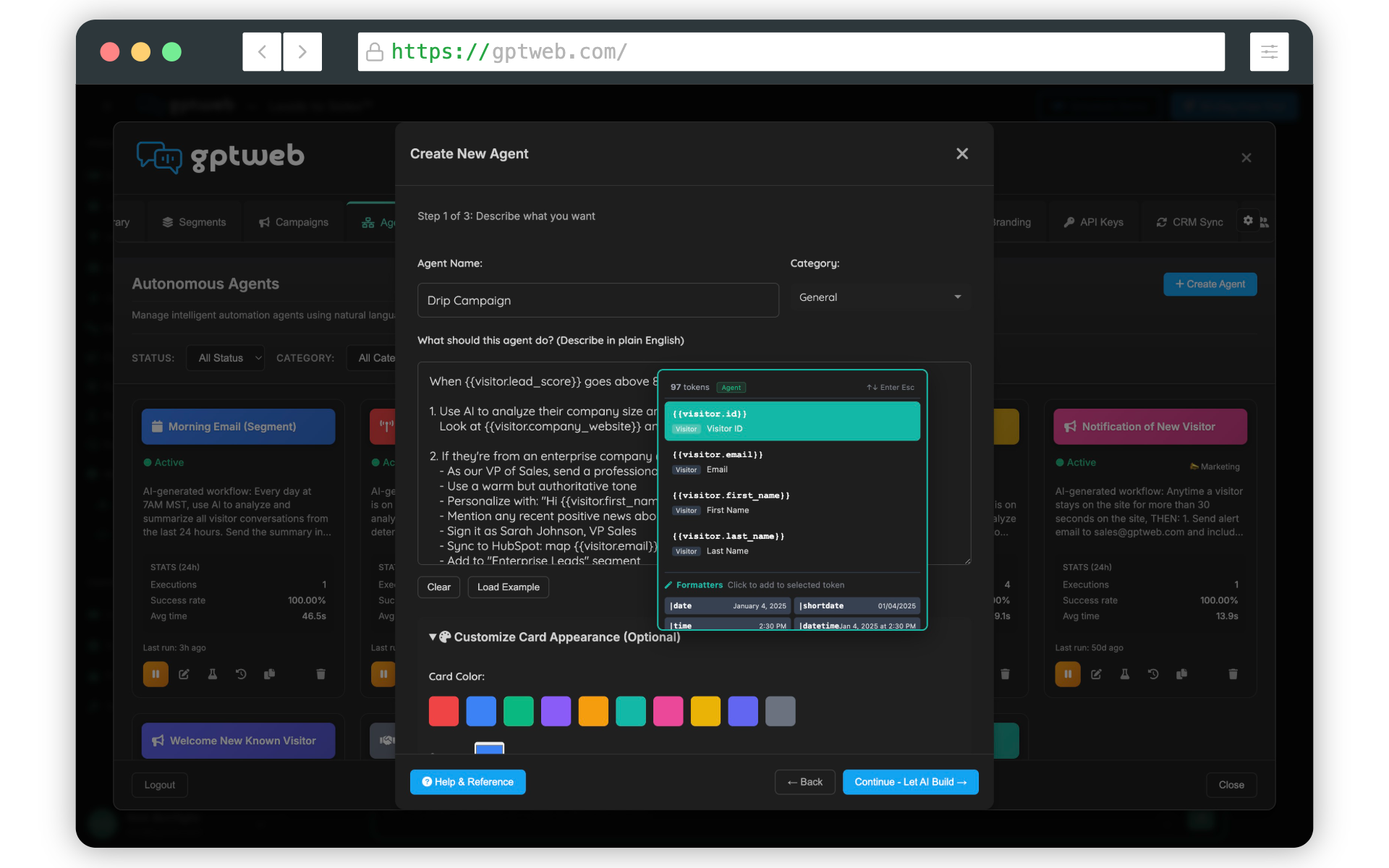
Here's where GPTWeb fundamentally differs from every other platform: Agents are autonomous workflows that execute based on visitor behavior, conversation content, and AI-scored intent. They don't just send emails - they orchestrate your entire engagement strategy. What Agents Do:
• Send transactional emails when visitors reach specific engagement thresholds
• Trigger batch campaigns to entire segments on schedules
• Update your CRM with conversation summaries and intent scores
• Create tasks for sales when high-intent conversations occur
• Alert teams instantly when Discussion Qualified Leads emerge
• Enrich visitor profiles automatically using People Data Labs or Clearbit
• Fire webhooks to external systems for custom integrations
• Send transactional emails when visitors reach specific engagement thresholds
• Trigger batch campaigns to entire segments on schedules
• Update your CRM with conversation summaries and intent scores
• Create tasks for sales when high-intent conversations occur
• Alert teams instantly when Discussion Qualified Leads emerge
• Enrich visitor profiles automatically using People Data Labs or Clearbit
• Fire webhooks to external systems for custom integrations
Why Single vs. Batch Email Matters
GPTWeb intelligently determines whether to send emails one-to-one or in batch operations: Single Action Agents (Transactional):
When a trigger happens for an individual visitor:
• DQL threshold reached → Send personalized congratulations
• High-intent conversation detected → Alert sales immediately
• Specific question asked → Send targeted resource
• Form submitted → Send custom follow-up with conversation context Batch Action Agents (Campaigns):
When you want to reach entire segments:
• Every Monday at 9am → Send weekly digest to newsletter subscribers
• Monthly → Send product updates to active users
• Quarterly → Send re-engagement campaigns to dormant leads The platform decides automatically based on your trigger type. You describe what you want in plain English, and GPTWeb configures it correctly.
When a trigger happens for an individual visitor:
• DQL threshold reached → Send personalized congratulations
• High-intent conversation detected → Alert sales immediately
• Specific question asked → Send targeted resource
• Form submitted → Send custom follow-up with conversation context Batch Action Agents (Campaigns):
When you want to reach entire segments:
• Every Monday at 9am → Send weekly digest to newsletter subscribers
• Monthly → Send product updates to active users
• Quarterly → Send re-engagement campaigns to dormant leads The platform decides automatically based on your trigger type. You describe what you want in plain English, and GPTWeb configures it correctly.
Single vs. Batch Operations - When to Use Each
| Operation Type | Use Case | Trigger Example | Recipient Count |
|---|---|---|---|
| Single Action | Individual responses | Visitor reaches DQL score 85 | One person |
| Single Action | High-intent alert | Asks about enterprise pricing | One person |
| Single Action | Form follow-up | Submits demo request | One person |
| Batch Action | Weekly newsletter | Every Monday 9am | Entire segment |
| Batch Action | Product launch | Manual trigger | Target segment |
| Batch Action | Re-engagement | 30 days inactive | Dormant users |
Why Conversational SEO™ is Revolutionary
Traditional SEO requires:
• Manual keyword research
• Content writers creating blog posts
• Guessing what users want to know
• Content going stale over time
• High cost per piece of content GPTWeb's Conversational SEO™:
Automatically generates search-optimized static pages from your most popular AI conversations. Here's why this is transformative: The Virtuous Cycle:
Visitors ask questions in your AI chat
Popular questions become static SEO pages automatically
Those pages rank in Google with real user queries as content
Users click from search results
They're redirected to your AI chat with their question pre-filled
They engage, ask follow-up questions, become DQLs
New conversations create more SEO content The Result:
• Content scales with usage, not budget
• SEO reflects what users actually want, not guesses
• Pages auto-refresh every N hours with updated conversations
• Zero manual content creation required
• Search traffic converts higher because intent matches perfectly
• Manual keyword research
• Content writers creating blog posts
• Guessing what users want to know
• Content going stale over time
• High cost per piece of content GPTWeb's Conversational SEO™:
Automatically generates search-optimized static pages from your most popular AI conversations. Here's why this is transformative: The Virtuous Cycle:
• Content scales with usage, not budget
• SEO reflects what users actually want, not guesses
• Pages auto-refresh every N hours with updated conversations
• Zero manual content creation required
• Search traffic converts higher because intent matches perfectly
Traditional SEO vs. Conversational SEO™
| Aspect | Traditional SEO | GPTWeb Conversational SEO™ |
|---|---|---|
| Content Creation | Manual writing | Auto-generated from chats |
| Keyword Research | Guess what users want | Know from actual questions |
| Content Freshness | Goes stale | Auto-refreshes every N hours |
| Scalability | Limited by budget | Scales with site usage |
| User Intent | Assumed | Captured from real queries |
| Cost per Page | $500-$2000 | $0 (automatic) |
| Conversion Rate | Lower (generic content) | Higher (exact intent match) |
Why Collections and Chunking Matter
GPTWeb doesn't just dump your documents into a database and hope for the best. The platform uses intelligent collections to route questions to the right knowledge: Collection-Based Routing:
• Product questions → Routes to Product Knowledge collection
• Support questions → Routes to Support Docs collection
• Sales questions → Routes to Sales & Pricing collection Smart Chunking:
Documents are broken into ~500-1000 token chunks with overlap:
• Never splits mid-sentence
• Preserves paragraph structure
• Uses headers as boundaries
• Includes context from previous chunk to prevent information loss This means faster, more accurate responses because the AI searches smaller, domain-specific knowledge spaces instead of your entire corpus every time.
• Product questions → Routes to Product Knowledge collection
• Support questions → Routes to Support Docs collection
• Sales questions → Routes to Sales & Pricing collection Smart Chunking:
Documents are broken into ~500-1000 token chunks with overlap:
• Never splits mid-sentence
• Preserves paragraph structure
• Uses headers as boundaries
• Includes context from previous chunk to prevent information loss This means faster, more accurate responses because the AI searches smaller, domain-specific knowledge spaces instead of your entire corpus every time.
Why BYOK (Bring Your Own Key) is Strategic
GPTWeb doesn't mark up AI costs or lock you into proprietary infrastructure. You bring your own API keys for: AI Providers:
• Anthropic (Claude conversations)
• OpenAI (embeddings for semantic search) Email Service Providers:
• SendGrid (transactional and campaign emails)
• Mailgun (alternative delivery)
• Amazon SES (high-volume) Enrichment Providers:
• People Data Labs (contact enrichment)
• Clearbit (company intelligence)
• ZoomInfo (B2B contact data) Why This Matters:
• Full cost visibility - see exactly what AI costs you
• No vendor lock-in - switch providers anytime
• Access latest models immediately when providers release them
• No markup - we don't profit from your AI usage
• Enterprise compliance - your keys, your data, your control
• Anthropic (Claude conversations)
• OpenAI (embeddings for semantic search) Email Service Providers:
• SendGrid (transactional and campaign emails)
• Mailgun (alternative delivery)
• Amazon SES (high-volume) Enrichment Providers:
• People Data Labs (contact enrichment)
• Clearbit (company intelligence)
• ZoomInfo (B2B contact data) Why This Matters:
• Full cost visibility - see exactly what AI costs you
• No vendor lock-in - switch providers anytime
• Access latest models immediately when providers release them
• No markup - we don't profit from your AI usage
• Enterprise compliance - your keys, your data, your control
Why Agent Best Practices Prevent Chaos
Agents are powerful, but without discipline they create problems: Do's:
• Start simple - one trigger, one action, test before complexity
• Use 'fire once' - prevent spam from re-triggering
• Include context in alerts - sales needs to know WHY
• Test on yourself first - run agents on your own profile
• Monitor agent logs - catch failures early
• Set up fallbacks - what if CRM is down? Queue and retry Don'ts:
• Creating loops - Agent A triggers Agent B triggers Agent A = infinite disaster
• Too many emails - alert fatigue causes sales to ignore everything
• Vague alerts - 'New lead' without context is useless
• Complex conditions - hard to debug, prone to edge cases
• Ignoring errors - failed runs mean missed opportunities
• Start simple - one trigger, one action, test before complexity
• Use 'fire once' - prevent spam from re-triggering
• Include context in alerts - sales needs to know WHY
• Test on yourself first - run agents on your own profile
• Monitor agent logs - catch failures early
• Set up fallbacks - what if CRM is down? Queue and retry Don'ts:
• Creating loops - Agent A triggers Agent B triggers Agent A = infinite disaster
• Too many emails - alert fatigue causes sales to ignore everything
• Vague alerts - 'New lead' without context is useless
• Complex conditions - hard to debug, prone to edge cases
• Ignoring errors - failed runs mean missed opportunities
Why Context-Aware Layouts Enable Flexibility
GPTWeb sites can be accessed three ways, each with independent layout configurations: The Three Contexts:
• Standard - Direct browser access to your GPTWeb site
• Iframe - Embedded in a designated area of your existing site
• Widget - Floating chat bubble that expands to chat window Why separate configurations? Because user expectations differ: • Iframe embed on your homepage might show only chat, no branding (visitor knows they're on your site)
• Widget popup might show minimal UI to maximize chat space
• Standard access might show full navigation and branding All three inherit your base branding, support light/dark themes, work on all devices, and have separate layout presets. This means you can deploy GPTWeb alongside existing infrastructure without ripping and replacing anything.
• Standard - Direct browser access to your GPTWeb site
• Iframe - Embedded in a designated area of your existing site
• Widget - Floating chat bubble that expands to chat window Why separate configurations? Because user expectations differ: • Iframe embed on your homepage might show only chat, no branding (visitor knows they're on your site)
• Widget popup might show minimal UI to maximize chat space
• Standard access might show full navigation and branding All three inherit your base branding, support light/dark themes, work on all devices, and have separate layout presets. This means you can deploy GPTWeb alongside existing infrastructure without ripping and replacing anything.
From Conversations
Auto-Generated SEO
Autonomous
Agent Actions
Full Conversation
Lead Context
BYOK Direct
Cost Structure
GPTWeb exists because the web needed to evolve from documents to platforms, from static pages to dynamic conversations, from manual workflows to autonomous agents, and from guessing what users want to knowing from what they ask. Every feature - Conversational SEO™, Agent Orchestration, AI Segmentation, Smart Chunking, BYOK infrastructure, Context-Aware Layouts - exists to solve real problems that traditional websites and marketing automation platforms couldn't address. GPTWeb is the future of engagement, websites and marketing automation combined - built for the AI era, built for now. What specific aspect of the 'why' would you like to explore deeper?